Provincial News
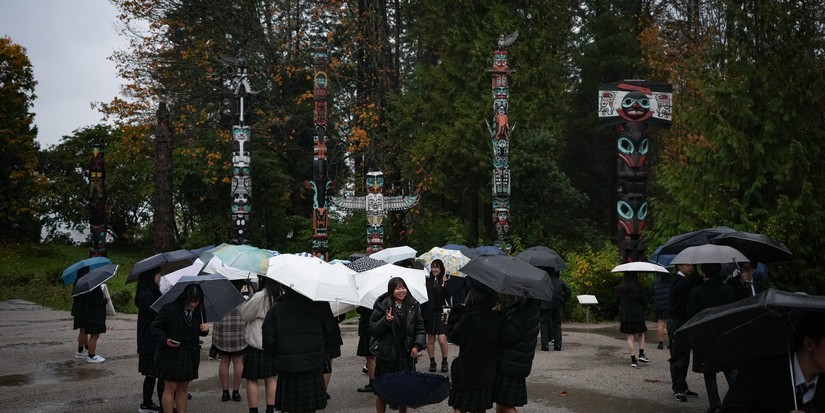
High school students from Japan use umbrellas to shield themselves from the rain while stopping to view the totem poles at Stanley Park, in Vancouver, on Saturday, Oct. 19, 2024.
THE CANADIAN PRESS/Darryl Dyck
Unusual atmospheric river will impact B.C. for days, even after it ends, says expert

Published 3:16 PDT, Thu March 19, 2026


-
The current atmospheric river drenching British Columbia is unusual, for both its duration and timing, says an Environment Canada meteorologist, and its effects will last for days, even after it ends.
"We typically don't seem to get atmospheric rivers this time of year that are quite this strong," Brian Proctor says in an interview.
While storms in March are not unusual, per se, it is unusual to see storms with so much rain last so long, he adds.
The Pacific region around Hawaii is the source of the rain, he says.
"So, the warmer an air mass is, the more moisture it can carry, and when you get an atmospheric river, you basically start directing it like a fire hose onto certain portions of the coast."
What is unusual about this storm is its length of intense rainfalls, he adds.
While this phenomenon will require additional study, it is "largely due to a really, really strong ridge of high pressure that is centred off California that hasn't moved," he says.
As of Thursday afternoon, Vancouver had received 79.8 millimetres of rain in 48 hours, putting it on track to surpass the record 103 mm that fell in 48 hours on Nov. 14 and 15, 2021, Proctor says.
Rain shadow effects from the Vancouver Island mountains can protect some areas from atmospheric rivers, he says, but in this case the storm was so large it overwhelmed those effects.
With temperatures rising, snowpack in some places is melting, adding to the flooding risk, Proctor says.
Rivers are rising across the province. The Nooksack River in Whatcom County, Wash., is also rising and could cause flooding in the Abbotsford, B.C., area similar to what happened in November 2021 when flooding devastated the Fraser Valley, Emergency Management B.C. said in a news release Thursday.
Several communities in the Fraser Valley have issued states of local emergency. The District of Hope declared one Thursday as did Kent and Harrison Hot Springs.
Several schools in the Fraser Valley are closed Friday, and the Trans-Canada Highway is closed in Hope.
"This is a very significant rain event, one that will stress our systems in many locations," Proctor says.
The good news, he says, is that the atmospheric river will end. But the bad news is that the effects — high, flooded rivers — will last for days afterward.
"The rivers won't peak until well after the rain has ended, so we're going to be watching rivers for quite a while yet," Proctor says.
There is also more rain forecast for Saturday, he says.
While rain events are not uncommon in B.C., what is unusual about this one is its timing, Proctor says.
March atmospheric rivers, while they do occur, tend to be weaker — this one is at a strength typically seen in November or December, he says.
It is possible this is related to climate change, Proctor says, but he doesn't want to draw that conclusion without further study.
"With climate change, we do expect to see intensification of precipitation events, but I don't want to be the one who definitively says this is because of climate change without more study," Proctor says.
The storm has also impacted power in B.C. BC Hydro reports about 15,000 customers are currently without power. Most of those are on Vancouver Island and in the Fraser Valley.
Environment Canada has issued rainfall warnings for Metro Vancouver, the Fraser Valley, Howe Sound and Whistler, Vancouver Island, the Sunshine Coast and other areas.
This report by The Canadian Press was first published March 19, 2026.











2 Hours of free financial consulting
Jai Xin Planning Ltd.
C$120.00 C$0.00

Use any of our home staging service and get a second month rental for free!
MiiX Interiors
C$500.00 C$0.00

Get 10% off any order
Phantom Screens Lower Mainland
C$200.00 C$180.00