Arts & Culture
Photos Courtesy DJ Scammell

Photos Courtesy DJ Scammell
Fashion for Men - Men’s Wingtip Dress Shoes

Published 2:21 PDT, Thu May 21, 2026


-
BY DOUGLAS JAMES SCAMMELL
Men’s Wingtip Dress Shoes
There are many different styles of dress shoes for men’s fashion. I have already written several articles covering a selection or different options when it comes to men’s shoes, some of them like: the monk strap, oxfords, to the Gucci Horsebit 1953 Loafer loafers, and loafers with tassels.
Here is yet another great man’s dress shoe to consider when shopping for foot- wear, and this one is best known as the “wingtip,” which is a classic men’s dress shoe defined by the decorative toe cap that forms a “W” or wing-shape, extending from the centre towards the sides of the shoe, clearly with the “W” design.
Style Description
The most common alternative name for the wingtip dress shoe is a “full brogue’. Why? because of the perforations (broguing). The true defining feature of a brogue is the decorative punching (broguing) along the leather edges. A traditional wing- tip is, by definition, a "full brogue" because it features these perforations along the wing-shaped cap, sides, and frequently a decorative "medallion" on the toe.
History
The wingtip dress shoe has a history spanning over 400 years, evolving from a strictly utilitarian, rugged country shoe in Scotland and Ireland into a versatile, stylish wardrobe staple. Throughout the 18th and 19th centuries, these shoes were considered inappropriate for any setting other than the outdoors. They were functional footwear for farmers and hunters for walking through swampy Irish and Scottish terrain, where the holes allowed water to drain. Wingtips eventually shifted from rugged country gear to a staple of the urban elite in London.
It is worth mentioning that there are 2 different styles offered - Longwing and Shortwing:
• Shortwing: The most common style, where the wings extend halfway along the side of the shoe.
• Longwing: A variant popular in the U.S. in the 1970s, where the perforations run from the toe all the way to the heel seam.
The shoe’s rise in popularity really started in the early 1900s when British aristocrats adapted the shoes for country walks and hunting. The style gained a major boost from the then Edward VIII, who wore two-tone wingtips (spectators) for golf outings in the 1930s.
By the 1920s, the wingtip became popular in Canada and the United States following World War I, and later was worn by actors & style icons like Fred Astaire and Gene Kelly, who were also arguably two of the greatest dancing stars to ever grace the silver screen.
Today, wingtip dress shoes have experienced a major resurgence driven by the shoes' versatility, modern comfort, and a “new prep” aesthetic that blends classics style looks with today’s relaxed everyday styling. Once viewed strictly as formal or business footwear, the modern wingtip has been reimagined to bridge the gap between traditional professionalism and casual comfort.
Ways to style wingtip dress shoes:
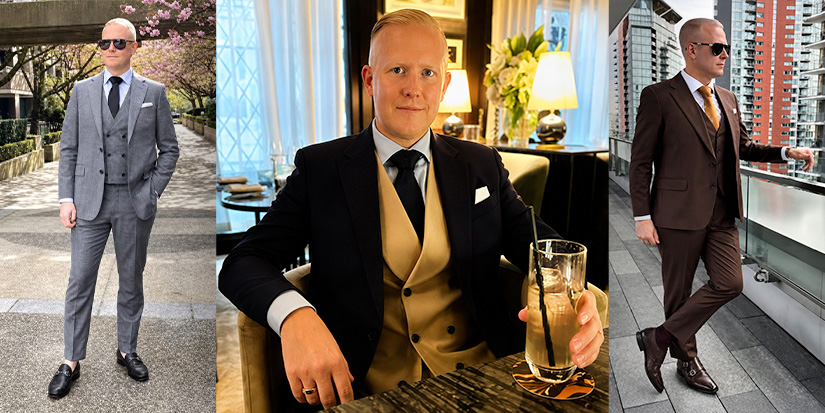
• With Suits: Stick to sleek, dark colored (black, dark, or oxblood) with minimal broguing for a professional look.
• Business Casual: Pair brown or tan derby wingtips with chinos, wool trousers, and a sport coat.
• Casual wear: Wingtips pair excellently with slim-fit dark wash denim. Avoid baggy pants that might bunch up over the shoes' detailed design.
• What to avoid: Never wear wingtips with a tuxedo, because the heavy decoration is considered too noisy and casual for proper black tie etiquette.
You can get many different price point options that fit your budget and needs. From wing- tips starting at under $100.00 and then ranging from above $200 to $2000.00 dollars... I recommend asking yourself a question: if you are going to be wearing these shoes a lot, you should invest in a more expensive pair that has better quality and the Goodyear welt bottoms, so that you can replace the bottoms and heels at your shoe cobbler rather than a cheaper pair that will just wear out fast, and little can be done by your shoe cobbler.




































.jpg)




.jpg)













































-825x413.jpg)










2 Hours of free financial consulting
Jai Xin Planning Ltd.
C$120.00 C$0.00

Use any of our home staging service and get a second month rental for free!
MiiX Interiors
C$500.00 C$0.00

Get 10% off any order
Phantom Screens Lower Mainland
C$200.00 C$180.00