Provincial News
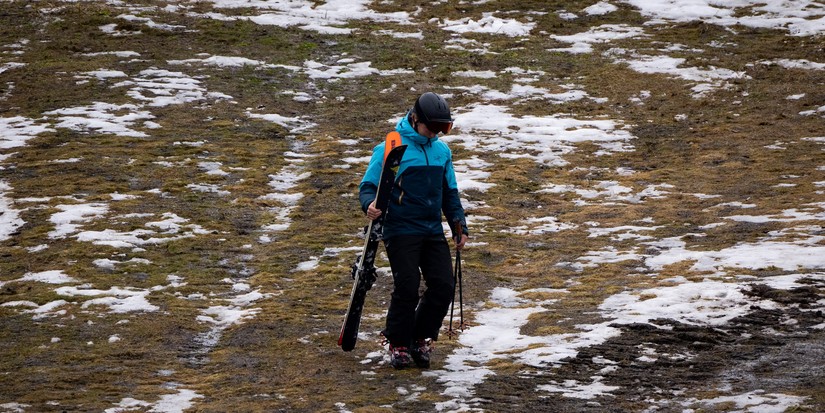
A skier walks down a patchy ski slope at Whistler, B.C., on Friday, December 29, 2023.
THE CANADIAN PRESS/Ethan Cairns
Vancouver closing out first no-snow winter in 43 years. There may be more on the way

Published 12:39 PDT, Thu March 19, 2026


-
Vancouver is poised to close out its first official snow-free winter in 43 years, in what environmental researchers say may become a new norm for southwestern British Columbia rather than an anomaly.
Friday marks the start of spring, and with temperatures forecast around 12 degrees, the city is sure to see out winter without having experienced the one centimetre of accumulation at the airport that is required to mark an official snowfall.
It's the city's first official no-snow winter since 1982-83, although Environment Canada meteorologist Brian Proctor says there were three days this winter with trace snowfall.
Vancouver's snowless winter is also on pace to be the city's second-warmest on record, with Environment Canada saying the mean temperature at the airport weather station was 6 degrees from December to February, well above the seasonal average of 4.3 C and only bested by the 6.3 degrees reported in 1958.
It's been a stark contrast to Central Canada, where Toronto-based Environment Canada meteorologist Gerald Cheng says the season dumped nearly 1.5 times the normal snowfall on the city.
Vancouver's snow-free season has not been lost on those in the ski industry.
Dave Brownlie, CEO of Whistler Blackcomb, says the resort saw about half the snowfall it would typically expect in November and December, forcing the mountain to open on a limited basis before snowfall improved in January.
"It's definitely been an interesting winter," Brownlie says. "There's been a lot of weather around North America. We've seen a lot of that happen."
Brownlie says the mountain got good snowfall in the new year and February, but dry conditions returned in March.
"We'll certainly get to spring with an early look and probably by mid-April it's going to look more like a typical spring situation," he says.
For the city's water supply, a snowless season has implications.
Metro Vancouver says the Capilano and Seymour reservoirs, which provide drinking water to the region, are at 74 and 70 per cent capacity respectively, though it says those levels should be replenished by spring rain.
The snowpack that accumulates in winter and melts in spring and summer provides a critical source of water for the region and province, says Jordan Richardson, a hydrologist with the BC River Forecast Centre.
"Generally speaking, the snowpack in the lower mainland watersheds is well below average," Richardson says. "We're probably sitting at about 50 per cent of normal."
University of British Columbia assistant professor Rachel White says a snow-free winter is visible evidence of climate change and its impact on daily life.
"I think what's interesting about this particular case is it's something very visible that people can see in their everyday lives," she says.
White says the lack of snow at lower elevations is consistent with climate change projections for the region and will likely become more common going forward.
"It's one of those things that can happen in any particular year, but we would expect the frequency of it to increase as time goes on," she says.
As for what to expect next winter, White says natural variability and unpredictability make predictions difficult.
Richardson says the lack of water will affect many areas.
"I think the key thing is to realize that it impacts so many different aspects of our lives, all the way from our drinking water supply, our supply for fighting fires, for sewage disposal, through the freshwater ecosystems, hydroelectric power generation, those things are all interconnected," he says "And the same water is used for many of those things.
"So if there's not much water, all of those things get impacted."
This report by The Canadian Press was first published March 19, 2026.










2 Hours of free financial consulting
Jai Xin Planning Ltd.
C$120.00 C$0.00

Use any of our home staging service and get a second month rental for free!
MiiX Interiors
C$500.00 C$0.00

Get 10% off any order
Phantom Screens Lower Mainland
C$200.00 C$180.00